

Café · Houston · ⭐ 9.1/10 · 854 reviews · updated: 2026-08-10 17:38:41
Address: 802 Shepherd Dr, Houston, TX 77007, United States
A Sunday school building from 1930, a food pantry through the lean years, then boarded up for most of a decade — and today one of the very few places in Houston where you can carry a coffee up to a roof deck. The Coffee House at West End is not a warehouse dressed up to look historic. It is genuinely old, the congregation that built it never sold it, and the whole project reads as a building being given a second job rather than a brand being invented.
Highlights
- A 1930 church education building. West End Baptist Church put up the three-story block and ran Sunday school in it for roughly four decades before the structure slid into disrepair.
- Beans from Little Dreamer Coffee. A Houston micro-batch roastery supplies the coffee; nothing is roasted on the premises, and the café has never claimed otherwise.
- Pastry from Koffeteria. Daily deliveries from the Cambodian-American Houston bakery that became the first bakery in the city named a James Beard semifinalist for Outstanding Bakery.
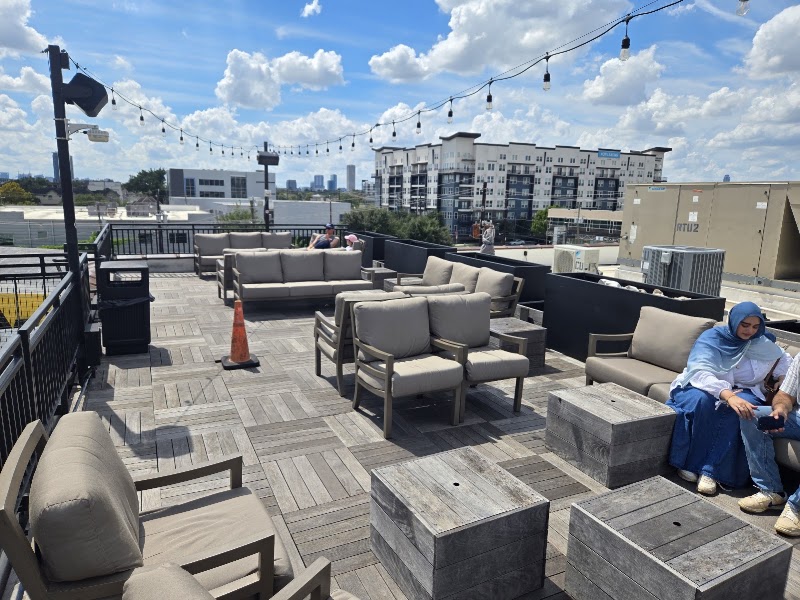
- A rooftop deck. Plus an outdoor gathering space and a play area at ground level — a combination that barely exists in Houston coffee.
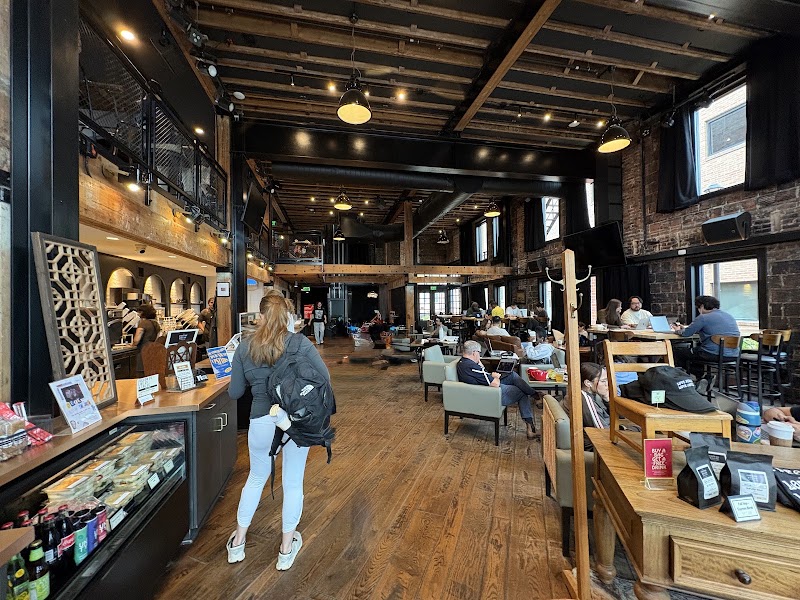
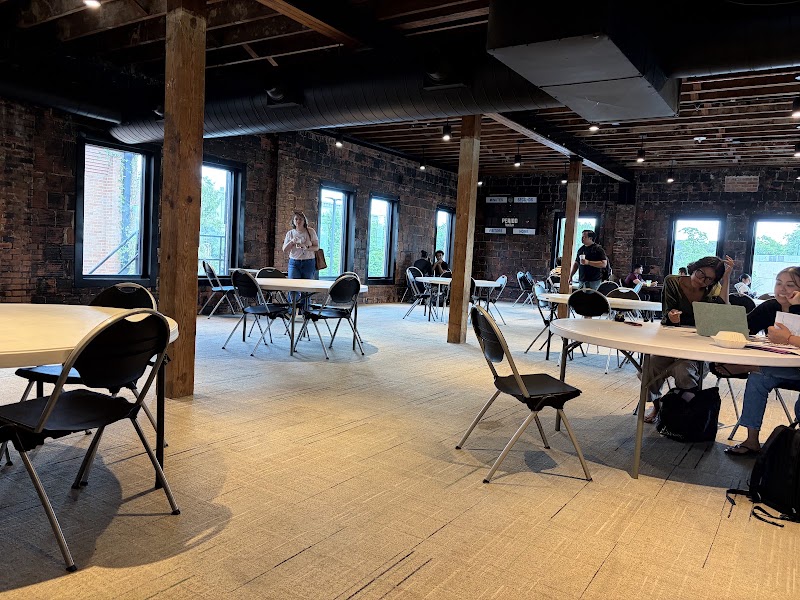
- A mezzanine where the second floor used to be. The renovation, finished in 2021, removed a whole level to open the room vertically across nearly ten thousand square feet.
- Acoustics designed on purpose. The upper floor doubles as assembly space, so sound was engineered into the redesign instead of being left to bounce off brick.
What’s in the cup
This is a café that buys its coffee rather than roasts it, and the choice is worth understanding before you order. The beans come from Little Dreamer Coffee, a small Houston roastery working in micro batches — a local-to-local arrangement rather than a bag flown in from a famous name on either coast. In practice that means the espresso is dialed to a single settled supply, and a room this size needs exactly that: the four hundredth flat white of a Saturday has to taste like the first.
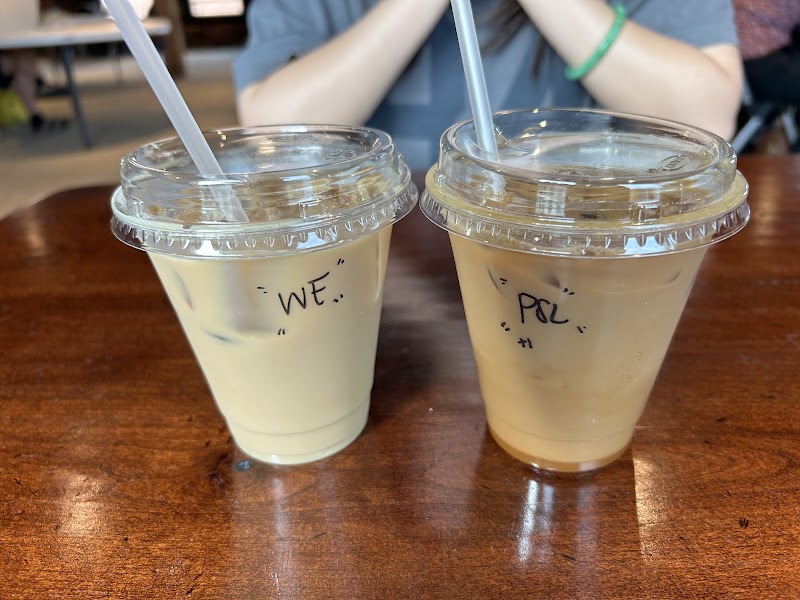
The drinks list follows the American neighborhood-café shape rather than the tasting-bar shape. Espresso with milk is the spine of the business, seasonal drinks rotate with the calendar, and there is a straightforward non-coffee side for the half of every table that came along for the company. What the café does not publish is an origin list, a rotating single-origin filter program or processing notes on a chalkboard. If you want to spend twenty minutes talking fermentation with the person on bar, there are labs in this city built for that conversation and this is not one of them. What you get instead is consistency and volume handled calmly, which is a genuinely different skill.
Worth saying plainly: beyond the roastery partnership, the café keeps a light public footprint about its coffee program. There is no long manifesto about extraction, no water spec, no published brew ratios. Treat the cup as a well-run neighborhood standard rather than a laboratory result, and the place makes complete sense.
Who’s behind it
The owner here is not a barista who saved up and signed a lease. It is a congregation. West End Baptist Church built the education wing in 1930 and used it for Sunday school for around forty years. When the building fell into disrepair in the early 1980s it kept working in humbler ways — a food pantry that fed hundreds of families, a place to pick up secondhand clothes and household basics — before being shuttered in the 2000s. In 2015 the old congregation merged with River Pointe Church and West End Church was formed; about five years after that, the church began the major redesign that turned the derelict wing into a coffee house.
That ownership explains almost everything about how the room behaves. The café’s own stated purpose is to serve the neighborhood through a love of people and a love of coffee, and the building is treated as community infrastructure that happens to sell espresso: it hosts events, it makes room for groups that need somewhere to meet, and it is comfortable with families in a way that pure specialty bars often are not. It also explains what is missing — there is no origin-chasing, no competition-barista mythology, no attempt to be the most talked-about cup in Houston.
Who it suits, and for what
Working with a laptop. The building was built to hold people for hours, and nearly ten thousand square feet means you are unlikely to be glared at for a second refill. The mezzanine and the upper level are where people settle in for real sessions. One caveat matters more than any other: that upper level doubles as bookable assembly space, so on an event day the quiet corner you were counting on may simply not be available. If a full working day is the plan, treat the ground floor as your fallback.
Talking to someone. The roof is the answer. It is the reason people drive here rather than to the drive-through closer to home, and a conversation up there in cool weather is a different proposition from a conversation in a strip-center café.
Coming with children. There is an outdoor play area. In a city where taking a small child to a specialty café usually means apologizing to three tables, that single amenity moves this place into a category of its own.
Meeting a group. The building is used to it. Community groups and support meetings use the space, and the acoustic work done during the renovation means a table of six does not ruin the room for everyone else.
Grabbing and going. Perfectly possible — there is online ordering — though the building rewards people who stay, and taking the cup back to the car misses the point of the roof.
The space
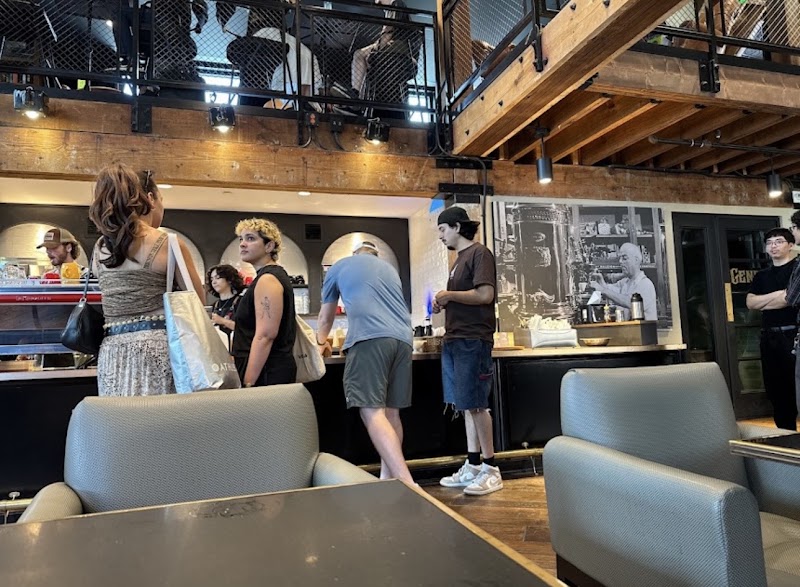
The renovation covered a little under ten thousand square feet and finished in 2021, and its boldest move was subtraction: the old second floor was taken out so the main room could run tall, with a mezzanine looking back down into it. The upper level works as assembly space, the roof became a deck, and the ground level gained an outdoor gathering area, a play space and a mural. The historic shell was kept rather than scrubbed — this still reads as a 1930s church building, which is precisely why it works.
The trade-off of a tall, hard-surfaced room is noise, and the design team knew it: sound was a stated priority of the redesign rather than an afterthought. It is still a big, bright, sociable space at peak, not a library. If you need silence, the roof and the far corners of the mezzanine are your friends.
What to eat with it
The kitchen question is simple to answer: there isn’t one in the baking sense. Pastry is brought in fresh daily from Koffeteria, a Houston bakery with a Cambodian-American identity and a genuinely serious reputation — it was the first bakery in Houston to be named a James Beard semifinalist for Outstanding Bakery. The offer is viennoiserie-led, sweet and savory both, and it holds up next to the coffee rather than existing as an afterthought at the till.
What that means for you is worth stating in the negative. This is not a brunch destination and does not pretend to be: no eggs cooked to order, no full plates, no lunch service to plan a day around. Come for coffee and something laminated, not for a meal.
When to come
The doors open before the start of the working day, which makes the café a viable stop on the way into town rather than a weekend-only outing. The single most useful scheduling fact is that the building closes on Sundays — the church that owns it has other uses for that day, and visitors who assume a Sunday-morning coffee run will find the lot empty.
Weekend afternoons bring families, the roof and the loudest version of the room. Weekday mid-mornings are the calm window if you want a table on the mezzanine without negotiating. And there is a seasonal layer specific to this city: the roof deck is a genuine attraction from late autumn through early spring and in the evening, while at the height of a Houston summer it is a short visit rather than a place to sit out a working session.
Getting there
The café sits in the West End, the low-rise pocket on the near northwest side that runs between Memorial Park and Buffalo Bayou, only a few minutes from downtown. There is no rail service in this part of town and no realistic walking catchment beyond the immediate blocks: this is a drive-to café in a drive-to city, and almost everyone arrives by car. Leave a margin at weekend peaks, when the neighborhood’s restaurants and bars are competing for the same space.
Finding it is easy in a way that GPS does not convey — the building stands on its own rather than tucked into a strip center, a solid brick block with a mural on it, which makes it one of the more recognizable buildings in the area.
Good to know
- Church-owned and community-first. Expect to share the building with a meeting, a group or an event; that is a feature of the model, not an interruption of it.
- The upper floor is bookable. Events take priority over your laptop, so a long working session is safer downstairs.
- Nothing is roasted here. The roastery relationship is the coffee story; there is no drum in the back.
- Sundays are closed. Plan around it — it is the most common mistake visitors make.
- The roof depends on the weather. Gulf humidity governs how long anybody stays up there.
- Public detail is thin. The café says little publicly about seating counts, sockets or its brewing spec, so anything beyond the roastery and bakery partnerships is best confirmed on arrival.
Questions and answers
Does the café roast its own coffee?
No. The beans come from Little Dreamer Coffee, a Houston micro-batch roastery. That is a deliberate arrangement rather than a gap — it gives a high-volume room a stable, local supply.
Is it a good place to work from?
Yes, with one caveat. The scale of the building means long stays are normal and nobody hurries you, but the upper level doubles as event space, so check that nothing is booked before you commit a whole day to it.
Do they bake on site?
No. Pastry arrives fresh each day from Koffeteria, a Houston bakery good enough to have become the city’s first James Beard semifinalist in the Outstanding Bakery category.
Can I sit outside?
Yes — there is a roof deck as well as an outdoor gathering area at ground level. The roof is the reason many people make the trip, and it is at its best outside the peak of summer.
Is it suitable for children?
Unusually so. There is a play area outdoors, and the building was renovated with families and community events in mind rather than as a quiet specialty bar.
What is the building’s history?
It was built in 1930 by West End Baptist Church as an education building, held Sunday school for roughly forty years, served as a food pantry and clothing point after falling into disrepair in the 1980s, closed in the 2000s, and was reopened as a coffee house following a renovation completed in 2021.
Is it open every day?
No. The café does not trade on Sundays, because the church that owns the building uses it differently that day.
Can I get there without a car?
Realistically, no. The West End has no rail service and the café is not in a walkable retail cluster; plan on driving, as most regulars do.
Is this a specialty coffee destination or a neighborhood café?
The second, with a specialty supply chain behind it. You get a locally roasted, consistently made cup in a remarkable building — not a rotating single-origin program or a tasting-flight experience.
Opening hours
| Day | Hours |
|---|---|
| Monday | 07:00–18:00 |
| Tuesday | 07:00–18:00 |
| Wednesday | 07:00–18:00 |
| Thursday | 07:00–18:00 |
| Friday | 07:00–19:00 |
| Saturday | 08:00–19:00 |
| Sunday | Closed |
Photos
Visitor reviews
Reviews last updated: 2026-08-10 17:38:41
Data is refreshed monthly. Sources: houstonka.com and editorial picks based on reviews.
Я можу відчути тиху та навчальну атмосферу, але також мати можливість проводити час з друзями за смачною кавою. Дуже гарне обслуговування, їжа та простір.
Я дуже часто сюди ходжу! Мені подобається атмосфера. Це найбільша кав'ярня в Х'юстоні! На всіх поверхах різний рівень шуму, тому тут чудово навчатися. Загалом це гарне місце. Напої та їжа смачні та швидко подають. Улюбле…
Кав'ярня «Кав'ярня у Вест-Енді» – це той тип місця, яке з часом непомітно заробляє свою репутацію. Воно не намагається вразити трендами чи театральністю; натомість воно пропонує послідовність, характер та відчуття спільн…
Я кілька разів заглядав до кав'ярні The Coffee House у Вест-Енді протягом довгих вихідних, працюючи віддалено, і це було чудове місце, щоб провести кілька годин. Кава була добротною, і приблизно за 3 долари за кухоль кав…
Дуже гарна кав'ярня, має 4 рівні, щоб знайти місце для навчання/роботи. Чисті туалети. Ми ходили в годину пік і все ж змогли знайти місце, щоб сісти. Напої були чудові, і випічка також. Однозначно рекомендую для побаченн…